
01
Live online course · Nov 9–18, 2026
Design AI products people understand, trust, and come back to.
The 2-Week Live Course: Designing Human-Centered AI Products. Four live evenings with Christian Kuhn. You audit a real AI product with the 7 Sins, redesign it with the 6 HAX Principles, and leave with a case study you can defend.
For product designers, UX researchers, design leads, and PMs who ship AI features.
 Hosted with Future Product Days
The 2-Week Live Course
Designing Human-Centered AI Products
- Dates
- Nov 9–18, 2026
- Time
- Mon + Wed, 18:00–20:00 CET (Copenhagen/Berlin time)
- Format
- 4 live lessons × 2 hours, online
- Recordings
- Posted within 24 hours, available for 6 months
- Certificate
- For all participants
- Refund
- 14-day refund window from course start
€249plus VATEarly Bird
Regular €390
Special price for FPD conference ticket holders at checkout.

Taught by Christian Kuhn. Leads the UX Center of Competence at Optimizer, Porto. Contributor to Harvard University DCE, Singularity University, NRI Japan and many more.
Human-AI Experience Design
Learn: Human-AI Experience (HAX) Design
We teach designers, product managers, and developers how to ship AI products people understand, trust, and choose to come back to, through the HAX framework and AI Product Design Patterns: workshops, courses, and consulting built on twenty years of fieldwork.
Why HAX
We have regressed to the command line.

0:00 / 0:00
Parts of this video are AI-generated. Can you spot which?
In twenty years of interface work, one lesson holds: the best interfaces disappear. You don't think about them, you just do things.
AI products broke that. The command line is back in the foreground, only now the parser gets moody and invents things. User tests keep proving the same point: the UX is not good.
Tool fluency is not product design fluency. Prompting is an afternoon of self-teaching. Designing AI products people understand, trust, and return to is the work nobody teaches well. Most AI failures are choice-of-application failures, not execution failures. Done right, human-centered AI design (HAX principles plus Human-in-the-Loop governance) returns a median ROI of +372%, and teams putting 25% or more of their AI budget into training see 2.4× higher median ROI.
hax.academy exists to fix that.
The framework
Name the Sin. Ship the cure.
One diagnostic lens, six load-bearing principles, and a five-phase map that tells you where each user interaction lives.
The 7 Sins of AI Product Design
- 01Vanity · the label without the value
- 02Mediocrity · good enough that beats nothing
- 03Gluttony · too many choices, cognitive paralysis
- 04Neglect · no guidance, no mental model
- 05Obscurity · no rationale, no confidence signal
- 06Tyranny · no escape, no override, no revert
- 07Envy · feature parity as strategy
A diagnostic frame, inspired by Kirstin Berman's Irrational Labs.
The 6 HAX Principles
02
Automation vs. Augmentation
Choose deliberately, every time.
Grammarly shows suggestions side by side and lets you pick — you stay the author.
03
Transparency & Confidence
Calibrate trust, don't manufacture it.
Google Flights doesn't say “73.4% confidence.” It says “prices are unlikely to drop.”
04
Real Control & Editability
AI output should never feel final.
Canva lets you apply an AI effect and revert it in one click.
05
Graceful Failure
AI fails differently than software fails; design for it.
Replit AI admits the bug, shows what it's trying, and lets you step in.
06
Mental Model Shaping
People don't have a model for AI yet; you give them one.
Apple Photos delivers a whole mental model in three placeholder words: “Photos, People, Places…”
Curated from the public canon: Microsoft HAX Toolkit, Google People + AI Guidebook, Apple HIG, GitHub, the Shape of AI, Build for Mars (Peter Ramsey's UX Research library), Real Life AI Design Pattern from aiverse.design, and pressure-tested with international client work by Optimizer.pt, and Senior designer/developer alumni.
The AI Product Journey
Every principle has an address on the journey and will be demonstrated with Real-World Examples and trained with realistic exercises (Miro + Design-Tool + AI-Tools).
How to design AI products
For anyone new to the field, here is what the work actually covers. The workshop trains each of these dimensions through real product examples and hands-on exercises.
UI patterns
AI features need their own interface grammar: suggestion chips, confidence indicators, compare modes, inline drafts, and undo surfaces. We map each pattern to the user decision it supports.
Input types
Voice, text, image, document, gesture, or sensor feed. The right input depends on context, error cost, and user intent. We choose inputs deliberately, not default to the chat box.
Flows
AI changes the sequence of a task. We design when the system acts, when it asks, when it hands back control, and what happens when the output is wrong.
Language, wording & labels
Words shape trust. We replace vague AI labels with specific promises, replace confidence scores with plain-language likelihoods, and write error messages that help users recover.
Scaffolding
Onboarding, empty states, examples, and progressive disclosure teach users how to work with the AI without reading a manual.
Behavior, not just screens
The visible UI is only half the product. We design the underlying behavior: when the model runs, what it returns, how it fails, and how it explains itself.
These dimensions are drawn from the public canon: Microsoft HAX Toolkit, Google People + AI Guidebook, Apple HIG, the Shape of AI, aiverse.design, and real-world AI UX audits from Optimizer client work.
AI Product Design Patterns
We are using Real-World AI UX examples. Screencast Videos and UI Screenshots from our Partner aiverse.design and our own Collection and Use-Cases. Additionally we offering "Learning Pathways" curated with Peter Ramsey's UX research library: Build for Mars.


Vizcom — expressive input. Source: aiverse.design
HAX helps fighting unethical AI Design
Generative AI products have quietly imported the variable-reward play from social media, now wrapped in token economies that look uncomfortably like chips on a casino table. This multimedia article, inclusive a Spotify audio and YT Video, examines the intersection of behavioral science and emerging tech, the ethical conflicts, and what UX designers should audit.
Read, listen or watch, the Multimedia Article on Devm.io
Illustration by Ivone Correia
A LEARNING DESIGN GAME
Explore the Card Deck and test yourself with the Spiral Game. A hands-on way to recognize the 7 Deadly Sins of AI Product Design in real interfaces and practice the antidotes with your team.
Open the 7 Sins of AI Card Deck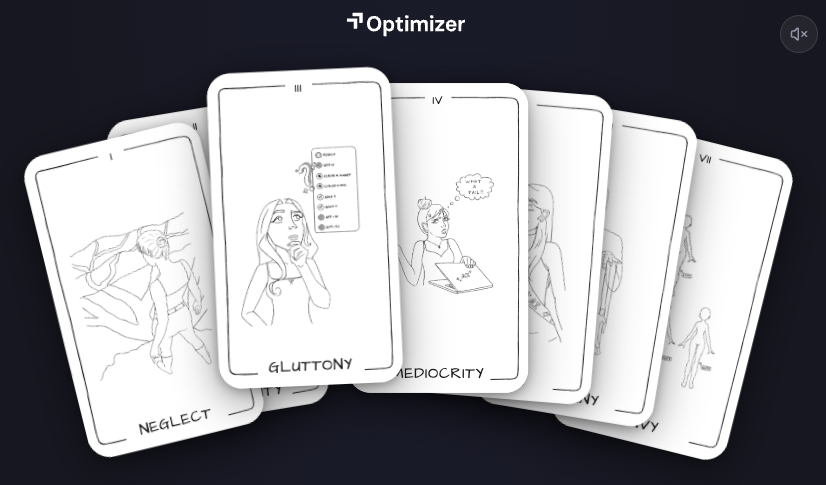
Learn it. Apply it. Ship it.
Choose your depth.
In person · full day
→
The Full-Day Workshop
Six load-bearing principles. One full day. Your product on the table. Audit a real AI product with the 7 Sins, redesign it with the 6 HAX Principles, and prototype the unhappy paths.
09:00–17:00 · groups of 4–5 · you leave with an audit, a redesign brief, and a working prototype
Next workshop→
Online · live · 2 weeks
The 2-Week Live Course
4 × 2-hour live sessions · recordings included · certificate
See the live course →Online · hands-on · 4 weeks
The 4-Week Intensive
16h live + 8h recorded + 6h project work · certificate · taught in English. German on request
See the intensive →For teams & events
Webinars
The framework, delivered to your team or your conference, from the 20-minute conference format to the two-hour deep dive with Q&A.
remote · English or German · tailored to your product context
On demand
Videos, Podcasts, Whitepaper
Recorded talks & discussions. Watch, listen or read the thinking before you buy the training.
Consulting
Work with us directly
A 7 Sins audit of your AI product, a HAX redesign brief your team can ship, or hands-on enablement inside your org, built on our fieldwork in Pharma, Healthcare, Fintech, and Logistics.
Engagements start with a 30-minute scoping call
Where to find us
The next six months.
- Jul 28, 2026Details →Guest lecture — Dave Platt's UX Engineering course, Harvard University DCEOnline
- Aug 22, 2026Details →Talk & 90-minute workshop — AI ConnectRiga, Latvia
- Sep 22, 2026Details →90-minute workshop — Future Product DaysCopenhagen
- Oct 6–29, 2026Details →The 4-Week Intensive — TheStarterOnline, English
- Oct 26–30, 2026Details →Talks + full-day workshop — webinale Agentic Web WeekMunich
- Nov 4–5, 2026Details →Talk — Code Talks ConferenceHamburg
- Nov 9–18, 2026Details →The 2-Week Live Course — Future Product DaysOnline, Mon + Wed 18:00–20:00 CET
- Feb 24–25, 2027Details →Talk & full-day workshop — prompt:UXBerlin
Want a private date for your team?
What practitioners say
Rated by people who ship AI for a living.
5.0 / 5
Conference average: 4.34
Webinale, Berlin 2026
Webinale, Berlin 2026
4.67 / 5
“Don't Make Me Prompt”,
DevSum, Stockholm 2026
DevSum, Stockholm 2026
4.64 / 5
Nordic UX Aarhus,
Denmark 2026
Denmark 2026
“The frameworks you built around trust, transparency, control, and graceful failure … are now part of how I evaluate every AI decision I encounter at PepsiCo.”
Nathy Tanner
PepsiCo
1 / 4
Taught and spoken at
Harvard University DCEAI Connect.lvPorto Tech HubFuture Product DaysWebinale Web WeekDevSumNordic UXGerman UPATheStarter.ioISEP PortoWe.Test AthensCode<>TalksPortoAXOptimizer.pt AI Literacy
Who is behind hax.academy
Christian Kuhn
Bridging Human Needs and AI Capability through Behaviorally Informed UX Design
Christian has over 20 years of international UX experience and currently leads the UX Center of Competence at Optimizer in Porto, Portugal. He drives the development of award-winning, user-centered product solutions through UX research and Behavior informed design. He contributes to Harvard University DCE, Singularity University, Nomura Research Institute Japan, and many more. He is a published author on UX Design, AI Product Design and Behavior Design topics. He is teaching UX Leadership, Behavior Design and Human-Centered AI Experiences (HAX) at TheStarter.io. PortoAX Activist. Jury Member of the UX Nordic Award 2026.
- International UX Product Award 2020 winner
- Author, Educator, Speaker
- Curator of the 6 HAX Principles
Member of






The prompt-free future
is not coming. It is here.
The only question is whether you will design for it.